
Many sailors dream of sailing around the world. Fewer know how to do it safely.
The biggest challenge is not distance. It is timing. You must move with the seasons, avoid storm zones, and plan each leg carefully. This guide explains a proven two-year (to 25-month) circumnavigation route from Europe and shows how to reduce risk along the way, especially for those planning Bluewater cruising.
What Route Do Most Sailors Take to Circumnavigate the World?
Most sailors follow the trade winds and sail west. This route avoids strong headwinds and reduces exposure to severe weather. Which is why it’s a standard route for Bluewater cruising and long-distance sailing.
For a well-supported and highly structured experience, we strongly suggest referring to the World Cruising Club (WCC) rallies, which outline a comprehensive 25-month passage around the world. The Oyster World Rally also follows a very similar route. Following these established paths is highly recommended for anyone looking into the WCC or ARC (Atlantic Rally for Cruisers).
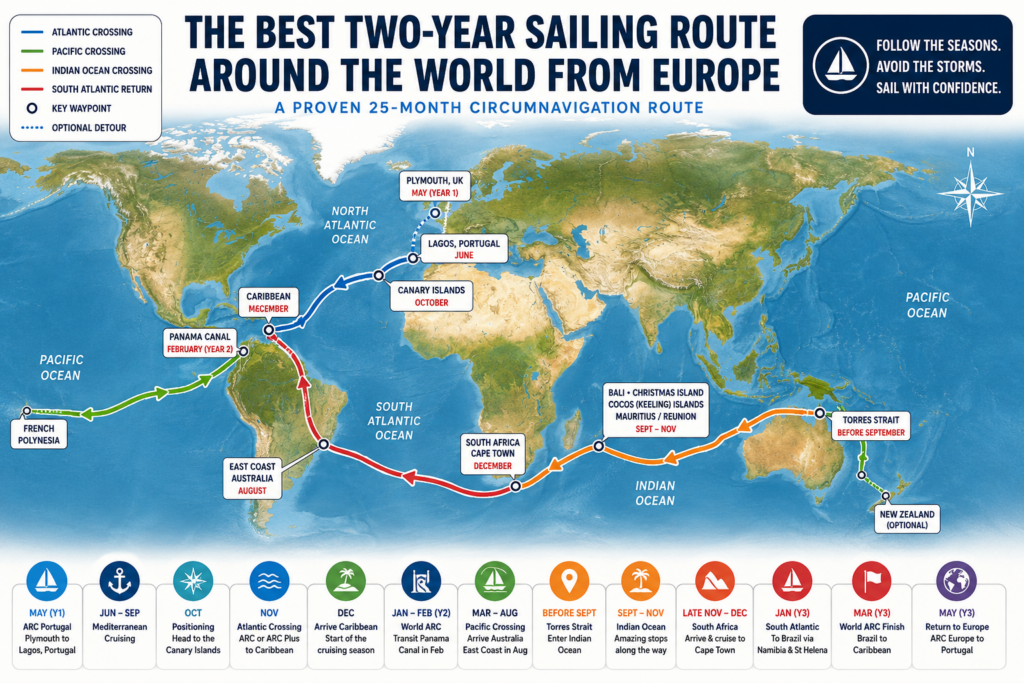
A typical journey starts in Europe, heads south to the Canary Islands, crosses the Atlantic to the Caribbean, passes through the Panama Canal, continues across the Pacific, crosses the Indian Ocean, rounds South Africa and returns north across the Atlantic to Europe.
When Should You Leave Europe to Sail Around the World?
Timing your departure is very important. Many sailors choose to kick off their journey with ARC Portugal, starting in Plymouth in May and sailing down to Lagos in Portugal, arriving in June.
Yachts then typically spend a few months enjoying the Mediterranean over the summer. By October, it is time to join other vessels leaving the Mediterranean and heading south to the Canary Islands to prepare for the Atlantic crossing.
When Is the Best Time to Cross the Atlantic to the Caribbean?
The safest window for an Atlantic crossing is in November. This timing aligns perfectly with the world cruising club calendar.
Sailors departing the Canary Islands in November have two primary options:
- ARC: Sail direct to the Caribbean (best for more experienced crews)
- ARC Plus: Sail via Cape Verde
Both routes aim to arrive in the Caribbean by early December. This marks the start of the main cruising season when weather conditions are more stable, getting you settled well before Christmas.
How Do You Sail from the Caribbean to the Pacific Safely?
After arriving in the Caribbean and enjoying the holidays, yachts head off in January on the World ARC.
The goal is to transit through the Panama Canal in early February. This timing helps avoid arriving too early in the Pacific, where cyclone risk remains high at the start of the year. Once through the canal, sailors continue west into the South Pacific.
When Should You Cross the Pacific Ocean on a Circumnavigation?
The Pacific crossing requires careful timing and covers vast stretches of ocean.
After transiting the canal in February, crews spend the spring and summer crossing the Pacific. The target is to arrive on the East Coast of Australia by August. Along the way, some yachts choose to detour via New Zealand. This stage includes long ocean passages and remote sailing, so crews must be ready for limited support and be completely self-sufficient.
How Do You Avoid Cyclones in the Indian Ocean?
Cyclone seasons dictate the Indian Ocean passage.
Sailors must make their way through the Torres Strait before September. From there, they head across the Indian Ocean. This leg offers incredible stops, including Bali, Christmas Island, the Cocos (Keeling) Islands, and Mauritius or the Reunion Islands.
The passage to South Africa needs to be timed with care. Yachts should arrive on the East Coast of South Africa by the end of November, allowing them to cruise down to Cape Town in time for Christmas.
What Is the Safest Way to Return to Europe by Sea?
After reaching South Africa, the return journey begins.
In January, sailors start the passage across the South Atlantic to Brazil, typically stopping via Namibia and St Helena. From Brazil, you sail back up to the Caribbean, arriving in March to officially complete the World ARC.
Crews then spend a few months working their way up the Windward and Leeward Islands. Finally, in May, it is time to sail back across the North Atlantic to Portugal on ARC Europe. Some yachts may choose to head back to the Canary Islands or sail straight back to Plymouth.
The 25-Month World ARC Timeline at a Glance
| Month / Year | Stage of Voyage | Route & Destinations |
| May (Year 1) | Departure | ARC Portugal starts in Plymouth, heading to Lagos, Portugal (arrive June). |
| Summer | Med Cruising | Spend a few months sailing the Mediterranean. |
| October | Positioning | Leave the Med and head down to the Canary Islands. |
| November | Atlantic Crossing | ARC (direct to Caribbean) or ARC Plus (via Cape Verde). |
| December | Arrival | Arrive in the Caribbean for the start of the cruising season. |
| Jan – Feb (Year 2) | Panama Canal | Head off on World ARC in Jan; transit the canal in early Feb. |
| Mar – Aug | Pacific Crossing | Cross the Pacific; arrive on Australia’s East Coast in Aug (optional NZ detour). |
| Before Sept | Torres Strait | Pass through Torres Strait into the Indian Ocean. |
| Sept – Nov | Indian Ocean | Stop at Bali, Christmas Island, Keeling Islands, Mauritius/Reunion. |
| Late Nov – Dec | South Africa | Arrive East Coast South Africa; cruise to Cape Town for Christmas. |
| January (Year 3) | South Atlantic | Passage to Brazil via Namibia and St Helena. |
| March | World ARC Finish | Sail from Brazil up to the Caribbean to complete the World ARC. |
| Spring | Island Hopping | Work up the Windward and Leeward Islands. |
| May | Return to Europe | Cross North Atlantic to Portugal on ARC Europe (or to Canaries/Plymouth). |
Is a Circumnavigation Realistic for Families and Flexible Travelers?
Absolutely. A common misconception is that a circumnavigation must be completed in one continuous, gruelling push.
Flexibility is built in: It is entirely possible to stop off at almost any major location, securely berth your yacht, fly back to the UK, and restart your voyage the following year.
Families on board: Many young families undertake this journey. Long-distance sailing offers a unique environment for home-educating children on passage, turning the world into an interactive classroom.
What Are the Biggest Risks When Sailing Around the World?
Weather is one of the greatest risks, as storms, cyclones, and changing sea conditions can develop quickly.
Long passages increase isolation. Crews must handle problems without immediate support. Equipment failure becomes more likely over time, especially on heavily used systems. Navigation also requires constant attention, as coral reefs, narrow channels, and busy shipping routes leave little room for error.
Do You Need Insurance for Circumnavigation?
A global voyage exposes your boat to different risks in different regions. Standard policies do not always cover offshore passages or cyclone zones. Your insurance should match your planned route and timing, whether you need cruising yacht insurance, bluewater cruising insurance, or boat insurance for cruisers.
Exposure to risk increases with long passages, remote sailing, and changing weather systems. Reviewing your cover before each leg of your cruising journey helps avoid gaps when you need support most. Choosing the best cruising boat insurance can make a significant difference on a long voyage.
How Should You Prepare Your Boat for a World Voyage?
Preparation determines how well your voyage unfolds.
Before you depart, make sure to check your hull, rigging, and sails. Engines and other critical systems must be serviced and tested. Navigation and communication equipment should be reliable and have back-up options. Then there are the non-negotiables of travel documentation, including visas and canal requirements. Don’t forget how much you will rely on weather routing tools and contingency plans throughout the journey.
Ready to Sail Around the World?
If you are planning a world sailing route, make sure your insurance is ready for the journey ahead.
From Atlantic crossings to remote Pacific passages, the right cover helps you manage risk with confidence. Whether you need cruising yacht insurance, bluewater cruising insurance, or flexible cover for long-distance sailing, it is important to choose a policy that matches your route, timing, and boat type.
Get a quote today and make sure your circumnavigation is protected from the start.
About Admiral Marine
We launched Admiral Marine in 1991 to provide flexible yacht and boat insurance for sailing and motor yacht owners. Our team understands what sailors need because we have real experience on the water. We offer cruising yacht insurance, motor cruiser insurance, and bluewater cruising insurance for coastal and offshore sailing. We manage claims in-house and give you access to a global network of surveyors and repair specialists. As part of the Hayes Parsons Group, a Chartered insurance broker with over 50 years of experience, we combine specialist marine knowledge with trusted expertise. Get a quote today and choose cover that matches your journey.
What is the best route for sailing around the world?
The safest route follows the trade winds westward via the Canary Islands, Caribbean, Panama Canal, Pacific Ocean, Indian Ocean, South Africa and back to Europe.
How long does it take to sail around the world?
Most organised circumnavigations take around 24 to 25 months, although many sailors pause their journey and continue the following season.
When should you cross the Atlantic by sailboat?
November is widely regarded as the safest time to cross from the Canary Islands to the Caribbean because hurricane season has ended and the trade winds are well established.
Can families sail around the world?
Yes. Many families complete world cruises while home educating children and taking advantage of flexible stopovers between ocean passages.
Do you need specialist insurance for sailing around the world?
Yes. Standard yacht insurance often excludes offshore passages or cyclone regions, making specialist bluewater cruising insurance important for circumnavigations.


